Monday, September 9, 2013

Up Country


This past weekend, we headed “up country” at the invitation of our landlady, Maureen. She and her family live on an acreage outside of Daylesford. I’ve heard people like them referred to as “blockies” – they have rural land, but not a farm. I think that term is usually used to describe people who have left the city to live in the country. Daylesford, in an old gold mining area, appears to be a progressive little town that attracts a number of tourists from Melbourne. If Deadwood married Sonoma and they had spa babies, it would look like Daylesford. One of the major attractions is an old convent that has been turned into an art gallery. The order of nuns who ran the convent, and the once girls boarding school, were of the Presentation Order. It so happens that all three of the nuns in my family were Presentation Sisters so visiting here felt somewhat familiar.

My aunts: Sr. Agnes, Sr. Bonnie, Sr. Peter
 
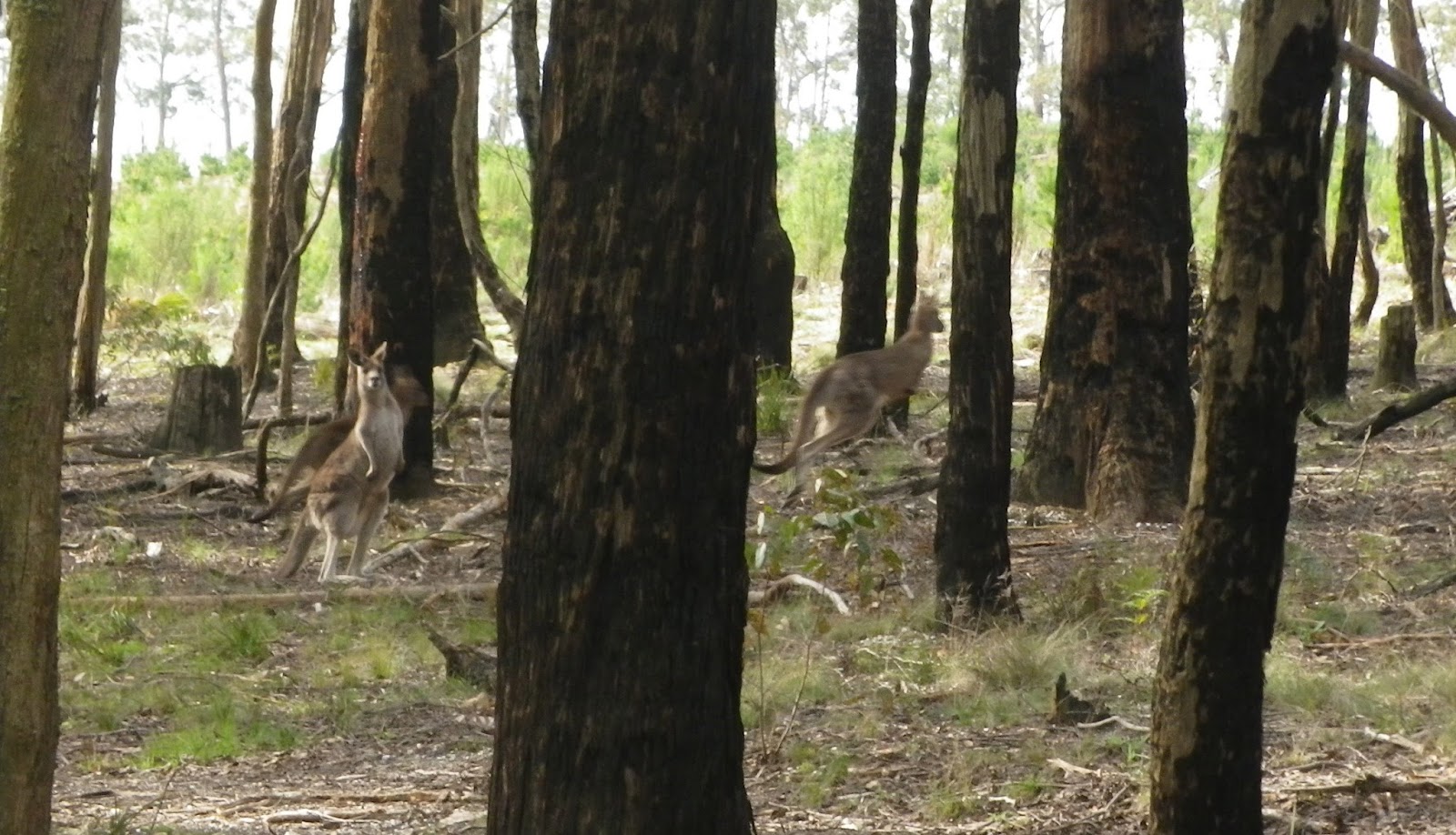
We walked around Daylesford for a few hours, but we spent most of our hiking time in the bush around Maureen’s house. The land is highly varied with cattle and sheep fields, eucalyptus forests, and pine tree farms for lumber. I was hoping for a koala sighting but instead saw many birds and kangaroos.


On one of our hikes, Andy and I explored a part of Hepburn Reserve. It was really magical, standing inside the forest surrounded by so many trees that they filled your entire field of vision. Maureen had told us that one of her neighbors often created art in the forest and we were keen to see it up close. The dot painting is likely an homage to the indigenous people. "Dot painting consists of various paint colors like yellow (the sun), brown (the soil), red (desert sand) and white (the clouds and the sky). These are traditional Aboriginal colours. Dot paintings can be painted on anything though in aboriginal times they used to paint dot pictures on rocks, caves etc." (Wikipedia, 2013)


This natural beauty is created by the eucalyptus gum tree. The sap literally sparkled in the sun.


We also came across some interesting cairns, no doubt created by this same neighbor. We were inspired to create some of our own Goldsworthian art.


Speaking of cairns, we are off to Cairns, Queensland, later this week for 6 days at the Great Barrier Reef. I hope we'll have some spectacular fish pictures to post next week.  

Thursday, September 5, 2013

The Flora of Deakin University, Warrnambool campus

I had some free time on campus today so I went on a hike in search of Alfred, the resident koala, but all I saw were these plants bursting into spring. I took pictures of many more but these are a few of the more interesting (and in focus) pictures.

Not a great picture, but such an interesting plant!

This plant came in a variety of colors.

Fireworks!

Up close!


Wattle, Australia's floral emblem


Pow.

Reminds me of the weed we used to call creeping jenny.

Looks like apple blossoms, on a small bush, on the ground.

Space age.

Looks like it's growing little meat pies.
And above the ground... trees.

Acacia

Eucalyptus

Another kind of eucalyptus

I never did see Alfred...


Wednesday, September 4, 2013

School Days, School Days


I had the pleasure of visiting a few primary schools in Warrnambool today. Warrnambool Primary School (a government school) was having a morning tea to honor the Deakin student teachers who were at their school, so a few of the faculty went out to be a part of it. There are about 600 students at this P-6 school. This is largest primary school in Warrnambool and has 3-4 teachers per grade level. The tea was held in the staff room – check out the comfy couches and the exercise equipment in that room!


I loved the original old building. It reminded me of Sacred Heart School where I went to grade school. But behind this older building, there were many new structures housing lots of classrooms.

At every school I go to, I have learned to ask, “What did you do with your stimulus money?” A few years ago, the Australian government doled out stimulus money to try to weather the global financial crisis. They chose to invest their money into schools. (The U.S. could take a lesson…) All schools were given a choice of multi-purpose or gymnasium structures. Some people complained because what some schools really needed were more classrooms, but still, the “stimulus buildings” I saw this week were pretty nice and appeared to be well-used.

After the morning tea at Warrnambool Primary, the Wellbeing Captain for Year 6 brought in trays of decorated cupcakes. She showed me which ones she decorated, and I told her, “I reckon you could give the Great Australian Bake-Off a go.” (I didn’t actually say it that way, but in my Australian, I might have said it in that way.) She let us know that they were selling them for $1 each to raise money for the RSPCA, and Bernadette and I each bought two of them. I asked her how students got to be captains, and she explained to me that they had five categories of captain: wellbeing, sustainability, sport, arts, and multimedia. In Year 5 they put their name forward and they were voted on by students in their house for the following year (there were 4 houses total). She told me that one of her functions as Wellbeing Captain was to be in charge of helping to organize fundraisers for various organizations in town and to have wellbeing activities at the school.

The second school we went to is my neighborhood’s school, Warrnambool East Primary School, which has about 500 students. This school wins many awards for the landscape gardens on their grounds. I can see why - they were really quite amazing. 


The school participates in a program where each class gets a creature that they use as part of their science curriculum. I saw a tree frog, an axolotl, and two bearded dragons. Very cool. A few weeks ago, I attended a lecture at Deakin by one of the professors who was studying this program. The purpose of the research is to assess the ways in which the animals are integrated into the science curriculum.


one of the classrooms at WEPS
 I sat and watched a class for about 20 minutes while my colleagues were talking with student teachers. One teacher was leading the class in a vote about what game they would play outside. There were 6 choices, or so. One of the choices was “Indians and Teepees,” which I thought was particularly intriguing. The group put their heads down and their hands up, and the teacher narrowed down the choices to Dodgeball and Gang Up Chasey. They voted again and Gang Up Chasey was the winner in the final round. Here they are playing it on their tremendous field area. Not sure what the rules of the game are, but I surmise it involves ganging up and chasing.


Monday, September 2, 2013

Going up the Country Schools


Today we were invited to ride along with my colleague Paula on a series of school visits in rural Victoria and across the border in South Australia. We left home at 8 am and returned at about 6:30 pm. Our drive took us across many, many kilometers of fields full of sheep and eucalyptus gum trees.


Our first stop was at a government P-6 school in the town of Woolsthorpe (pop. 694). In Australia, kindergarten is generally in a pre-school type setting the year before starting at a school, and the year prior to Year One, or first grade, is called Preparatory, hence the term “P-6.” The one original school building still stands, but behind it was a brand new set of buildings that the students and staff had just moved into five days ago! It still had new building smell. There are five classrooms in total, but the rooms have movable glass walls that can all be opened up to one large room. It totally reminded me of the open classroom years. You’ll see the iPads on the tables – each student in grades 3-6 had their own iPad on which they do most of their work. They have quite a bit of technology, an arts specialist, and a Chinese language teacher, but the general education teachers teach their own PE and music. The school has a garden and a commercial kitchen. From what I saw and heard, it’s a very progressive school.


The principal gave us a brief tour and invited us to morning assembly where the whole student body of 93 sang Australia’s national anthem. The principal introduced us to the students and some of them had questions for us. “Have you ever been to Bali?” (The twins had just returned from a trip there…) “Have you ever been to Germany?” (The young girl who asked was from Germany.) “Have you ever been to New Zealand?” (The girl was from New Zealand.) It became sort of comical how the students were all sharing their lives through their questions of us. One of the teachers in the back, presumably from England, raised her hand and said, “Have you ever been to England??” After all of this, the student teacher Hannah said she had a story about America. Her sister, Madeline, had just been recruited to play college basketball at the University of South Dakota. What kind of small world IS THIS?? I told them I grew up just 25 miles from there and Andy told the kids of how when he visited Vermillion he liked how the corn grew right up to the sidewalk on the edge of town. Hannah remarked that her sister said South Dakota reminded her of here. (I gather minus the eucalyptus trees…)
After a cup of coffee, some pink lady apples from the Year 6 teacher’s heritage orchard, and a bit more of a chat about Australia school systems, we made our way to the next stop, St. Joseph’s School in Coleraine (pop. 1383). The town of Coleraine is known for their breeding of Kelpy sheep guide dogs. We pulled up to the school grounds where there are 22 students in P-6. (The other 50 children in town attend the government primary school.) The kids were out on the playground for recess. After meeting the principal and the teachers, we were introduced to a Year 2 and a Year 6 student who informed us they were the captains of their grades, and they gave us a tour of the school garden. They had chooks (chickens), two sheep, a small shitake mushroom enterprise, some fruit trees that were espalier, and a number of garden boxes full of vegetables. The Year 2 boy had lots to tell us about how much his dad contributed to the school farm. The older girl had just arrived in the past year after living the first part of her life in Perth and Melbourne.


We stopped for a visit in the student teacher’s classroom, which was well equipped with 12 (new looking, not those Apple II’s) computers for the 12 students. One student had a one-on-one aide. What was happening looked just like many classrooms in California. We walked along the cloakroom, looking at posters and artwork. Andy and I learned a new word from the anti-bullying poster: “dobbing – when a person tries to get attention or get someone else in trouble.”

After another hour or so of driving, we arrived in Mt. Gambier (pronounced Gambia – it wasn’t until I saw the road sign did I realize it was spelled with an “r”). Mt. Gambier (population 24,000) is in South Australia, a neighboring state, where the time zone is 30 minutes earlier. The first school Paula needed to visit required a “serious conversation” so she dropped us at Blue Lake with our take away lunch, and we enjoyed a leisurely stroll. Blue Lake is a volcanic crater. We’ll write more about that later – this is a post about schools.


When Paula picked us up again, we were off to Tenison Woods College. College is the term that is usually used to describe a high school, but in this case, it’s actually a Catholic P-12 school with 1400 students! (One third of all schools in Australia are parochial and the rest are public.) Paula went to talk with the student teacher and the principal took us on a brief tour of the grounds. He expressed pride in their special education program when he pointed to the 4 SPED rooms. It seems, from what I’ve seen, that special education in Australia is not as integrated as in the states. The principal highlighted the excellent athletics program. We commented on the girls playing basketball in the gymnasium. Basketball isn’t a huge sport here. He noted that they have a prestigious basketball camp every summer and take their basketball players on tours of the U.S. every two years, in part to scout universities who might recruit them with scholarships. They also had debate (yeah!) and a rather large music program with a focus on jazz ensembles.


We were welcomed so warmly at all of the schools. The kids and teachers really didn’t look too much different than many schools I’ve been to in the U.S. Having grown up in South Dakota, taught in a small Catholic school in rural Iowa, and now working in a rural part of California, I was reminded many times of these experiences as we walked the halls of these schools. The main noticeable differences to me were that there was far less racial diversity than in most of our California schools, and all kids in Australia wear school uniforms. They vary significantly from school to school, but they all have them. I’ve been quite conscious not to take pictures of students for privacy purposes, though our tour guides today would have made a great shot!


Sunday, September 1, 2013

For the Birds


I've been saving up some pictures of birds to share. One of the fun things is seeing all the birds here that are new to us. We haven't learned the names of all of them, so if anyone can name those we don't know, have a go. My favorite is still the superb fairy wren. They're so cute!

We've learned that Australia doesn't have white swans, only black ones. They are a very striking bird in the wild. We spotted these off the bike trail the other day, hanging out in the marshlands. I was waiting for them to meet up and make a heart shape with their necks, just like they do in the greeting cards.


 In Melbourne central business district, we managed to come across a few birds.

In a city park, looking for dinner

Some wood ducks probably waiting for bread crumbs


This black swan stalked tourists on the Yarra River boat ride
These two pigeons? greeted us outside of the Melbourne Museum

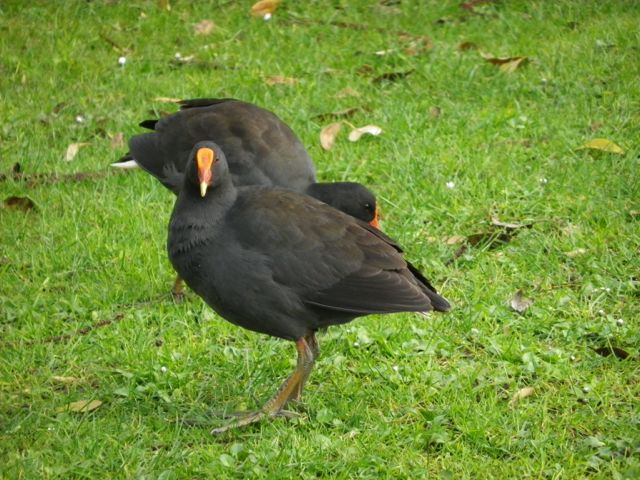
We took a hike around Lake Pertobe last week. It's the large park I wrote about in another post. It was the middle of a week day, so the park was inhabited mostly by wildlife - most of them birds. Andy had a face-off with a large magpie who looked ready to charge. We both flipped our hoods up and went on our way. The black and blue bird was one of the more interesting ones. I have no idea what kind it is, but it reminded me of a chicken as it came over the bridge.

Why did the black and blue bird cross the bridge?

To meet up with his mate.
There were many, many of these - maybe oyster catchers?

The heron posed for us.

A pelican, Andy's favorite bird.

This duck was sitting pretty - love the green feathers.

Duck, duck, goose?

The fella's lady friend was nearby.


Something we had heard about, and were anxious to visit, were the penguins on Middle Island in Warrnambool. We finally saw them on our bike ride this weekend. During some parts of the year, there's a live webcam where you can follow the little penguins. Out on the point are the cormorants, and to the left are a group of penguins that look kind of like they're sleeping because most of them have their heads tucked down.


A cormorant catching dinner.

In a couple weeks we'll be visiting The Great Barrier Reef, so I'm sure we'll have lots more fish pictures. It will be interesting to see what types of birds live up there as well.